
What Is a Zygoma Implant? A Definitive Solution for Advanced Bone Loss
For many patients who want to achieve a healthy smile and strong chewing function, implant treatment is the gold standard today. However, when you visit the dentist, if you hear the sentence "There isn’t enough bone left in your upper jaw to place an implant", you may have been disappointed. In the past, this meant patients were forced to use denture-based (removable) prostheses for life. But thanks to modern dentistry and the advanced surgical technologies of 2026, there is now hope: Zygoma Implant (Cheekbone Implant).
So, what is a zygoma implant, which saves the day in cases where standard implants fall short? Who is it suitable for, how is it performed, and what are its advantages? In this article, which serves as a true treatment guide, we answer all the questions in your mind.
What Is a Zygoma (Cheekbone) Implant?
Traditional dental implants are typically 8 to 12 millimeters long and are placed directly into the jawbone where the teeth are located (the alveolar ridge). However, due to long-term tooth loss, gum disease, or genetic factors, the upper jawbone can gradually resorb and become paper-thin.
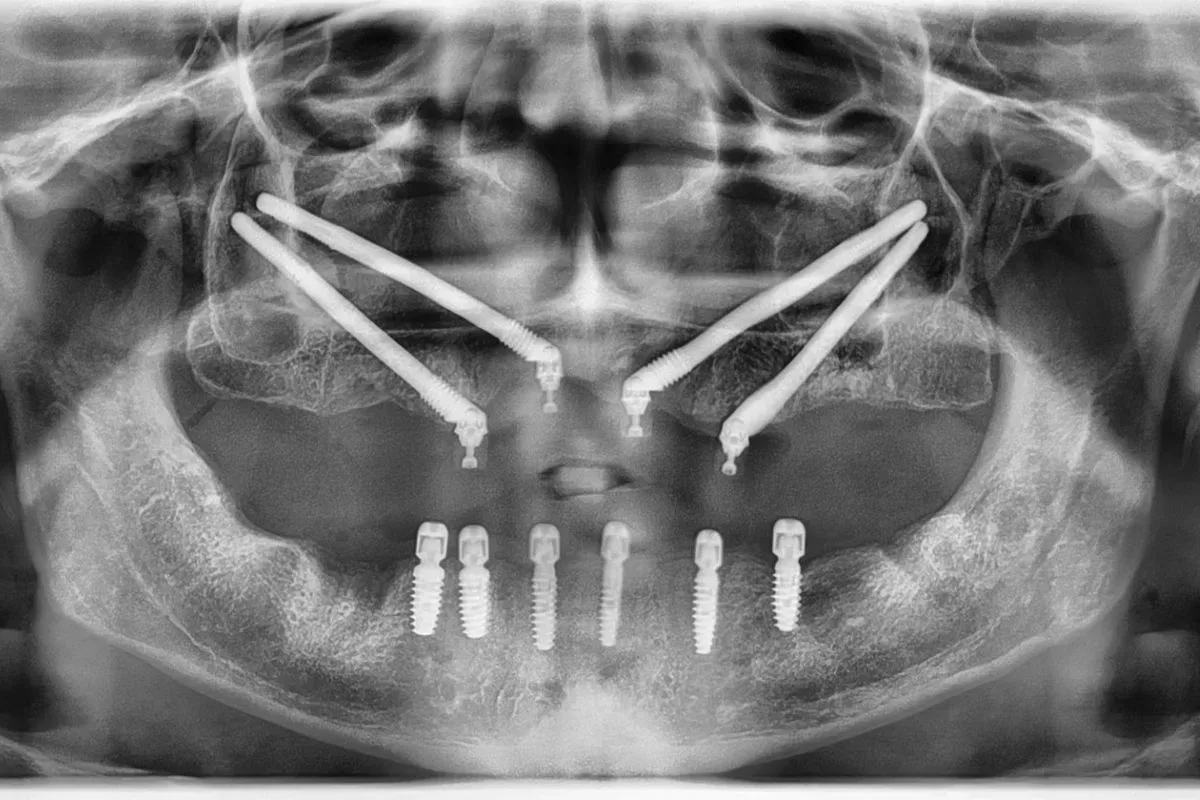
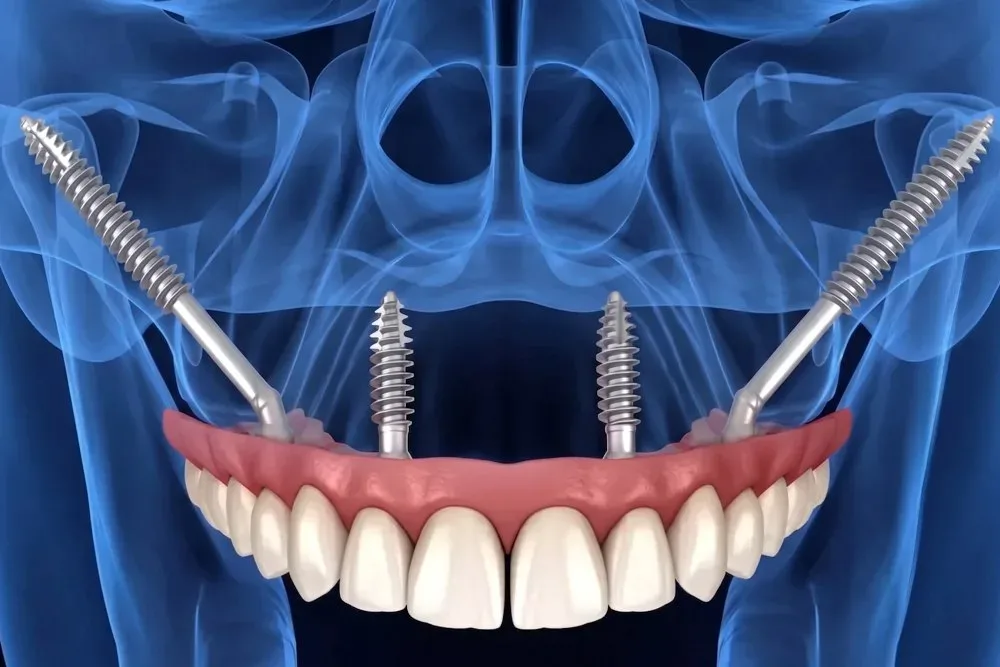
This is where the zygoma implant comes in: titanium screws measuring 30 to 55 millimeters, specially designed for patients who do not have enough bone volume in the jaw. These implants are anchored at an oblique angle not into the resorbed upper jawbone, but into the cheekbone (zygomatic bone), which is one of the strongest and most resorption-resistant bones in the face. In this way, a solid foundation is created inside the mouth, serving as an excellent support pillar for fixed dental prostheses.
What Are the Key Differences from Traditional Implants?
The features that distinguish zygomatic implants from standard implants are not only their size. The treatment philosophy is also completely different:
Placement Area: While standard implants are placed in the jawbone, zygoma implants are anchored in the cheekbone.
Length: They are nearly 3-4 times longer than normal implants.
Need for Bone Graft: If there is insufficient bone for standard implants, bone grafting and sinus lift procedures that take months are required. With zygoma implants, these difficult and lengthy processes are not necessary.
Who Are Zygoma Implants Suitable For?
Cheekbone implants are not an aesthetic choice, but a medical necessity. They are usually performed by specialized oral and maxillofacial surgeons for the following patient profiles:
Patients with Advanced Bone Loss: Patients who have no bone left in the upper jaw, even at a millimeter level, to support a standard implant.
Those Who Have Worn Dentures for Many Years: People who have used removable dentures for years due to complete tooth loss and have completely lost bone volume.
Those with a History of Failed Grafts (Bone Graft): People who previously underwent bone grafting but whose bodies did not accept it or whose operation was unsuccessful.
Those Who Have Experienced Bone Loss Due to Tumors or Accidents: Patients who have lost part of the jawbone as a result of cyst or tumor removal from the upper jaw area or severe trauma.
Those Who Want Fast Results: Patients who do not want to wait for the 6-8 month healing period of bone graft treatment and want to regain fixed teeth with a single surgical procedure.
How Does the Treatment Process Proceed? Zygoma Implant Step by Step
For many patients, the idea of “placing screws into the cheekbone” may seem intimidating. However, with an expert oral and maxillofacial surgeon and proper planning, the process is quite comfortable.
1. Detailed 3D Tomography and Digital Planning
First, a 3D dental tomography (CBCT) scan is taken from the patient. This allows the volume of the cheekbones, the condition of the sinus cavities, and the nerve pathways to be digitally mapped with millimeter precision. The angle at which the implant will be placed is determined on the computer screen before surgery.
2. Surgical Operation
Zygomatic implant surgeries are usually performed under general anesthesia or deep sedation in a fully equipped operating room, for the patient’s comfort and the precision of the procedure. The patient feels no pain, discomfort, or stress during the operation.
3. Placement of the Implants
Usually, 2 zygoma implants are placed in the upper jaw and 2-4 standard implants are placed in the front region, depending on the need (hybrid method). If there is no bone at all in the front region, full support is provided by using 4 zygoma implants (Quad Zygoma).
4. Fixed Teeth on the Same Day (Immediate Loading)
As soon as the operation is over, temporary fixed dental prostheses, prepared in advance in the laboratory, are screwed onto the implants. The patient enters surgery without teeth and wakes up to return home with fixed teeth.
5. Transition to Permanent Prostheses
It takes approximately 3-4 months for the cheekbone and implants to fully fuse (osseointegration). At the end of this period, the temporary teeth are removed and the patient’s permanent, zirconium or porcelain-based final teeth are fitted.
Key Advantages of Zygoma Implant Treatment
There are very strong reasons why this treatment has become popular in evolving dental protocols:
End of Bone Graft Burden: It spares the patient from procedures that take months and sometimes require hospitalization, such as harvesting bone from the hip or adding synthetic bone graft material.
Time Savings: While conventional bone augmentation treatments can take up to 1 year, with zygoma treatment you get your teeth on the first day.
Maximum Success Rate: Because the cheekbone has a very dense and strong structure, the implant’s success in attaching to bone (primary stability) is much higher than in standard bone.
Psychological Relief: The loss of confidence caused by removable dentures that can fall out of the mouth while speaking comes to an end with fixed teeth on the same day.
Contribution to Facial Aesthetics: The collapse that occurs around the lips and cheeks due to jawbone resorption is supported by implant-supported prostheses, resulting in a more youthful facial profile.
Postoperative Recovery and Care
Since the zygoma procedure is a major surgical intervention, swelling and mild bruising in the face (especially under the eyes and on the cheeks) during the first 3-4 days after surgery is completely normal. This condition is quickly brought under control with the medications prescribed by the doctor and cold compress applications.
During the recovery period (the first 3 months), patients must eat a soft diet (pureed foods) so as not to jeopardize the process of the implants fusing with the bone. In addition, maximum attention should be paid to oral hygiene, and special oral irrigators and interdental brushes should be used.
Zygoma Implant Prices 2026
One of the issues patients are most curious about is cost. Zygoma implant prices are higher compared to standard implants. The reasons include the special technology used in manufacturing the implants, the procedure being performable only by Maxillofacial (Jaw-Facial) Surgeons, and the operating room/general anesthesia expenses coming into play. A clear price can only be determined after the doctor’s clinical examination and 3D tomography analysis. However, considering the lifelong comfort of use and the quality of life it provides, this treatment is definitely an invaluable investment for the patient.
As a Result;
Bone loss is no longer your destiny. If your dentist tells you, "there isn’t enough bone, implants can’t be placed," this is only valid for standard treatments. Zygoma implant technology, by achieving what was thought impossible, offers you fixed, aesthetic, and strong teeth on the same day, even in cases of advanced bone loss. To reconnect with life through a healthy smile, be sure to get zygomatic implant consultation from a specialized oral and maxillofacial surgeon.